
Raven Chacon
Scores for Coming Storms
May 14–June 20, 2026
Sikkema Malloy Jenkins is pleased to present Scores for Coming Storms, a solo exhibition by Raven Chacon, on view in the back galleries from May 14 through June 20, 2026. A public reception with the artist will be held on Thursday, May 14, from 6–8pm.
Raven Chacon is a Pulitzer-Prize winning composer, performer, and artist from Fort Defiance, Navajo Nation. Through musical and visual compositions, Chacon explores the complex interactions between people, space, and sound. His works are often site-specific, engaging the material and sonic qualities of a given place to make perceptible what has been historically silenced or left out of the frame: legacies of colonial conquest and extraction, but also Indigenous memory, cultural narratives, and acts of resistance.
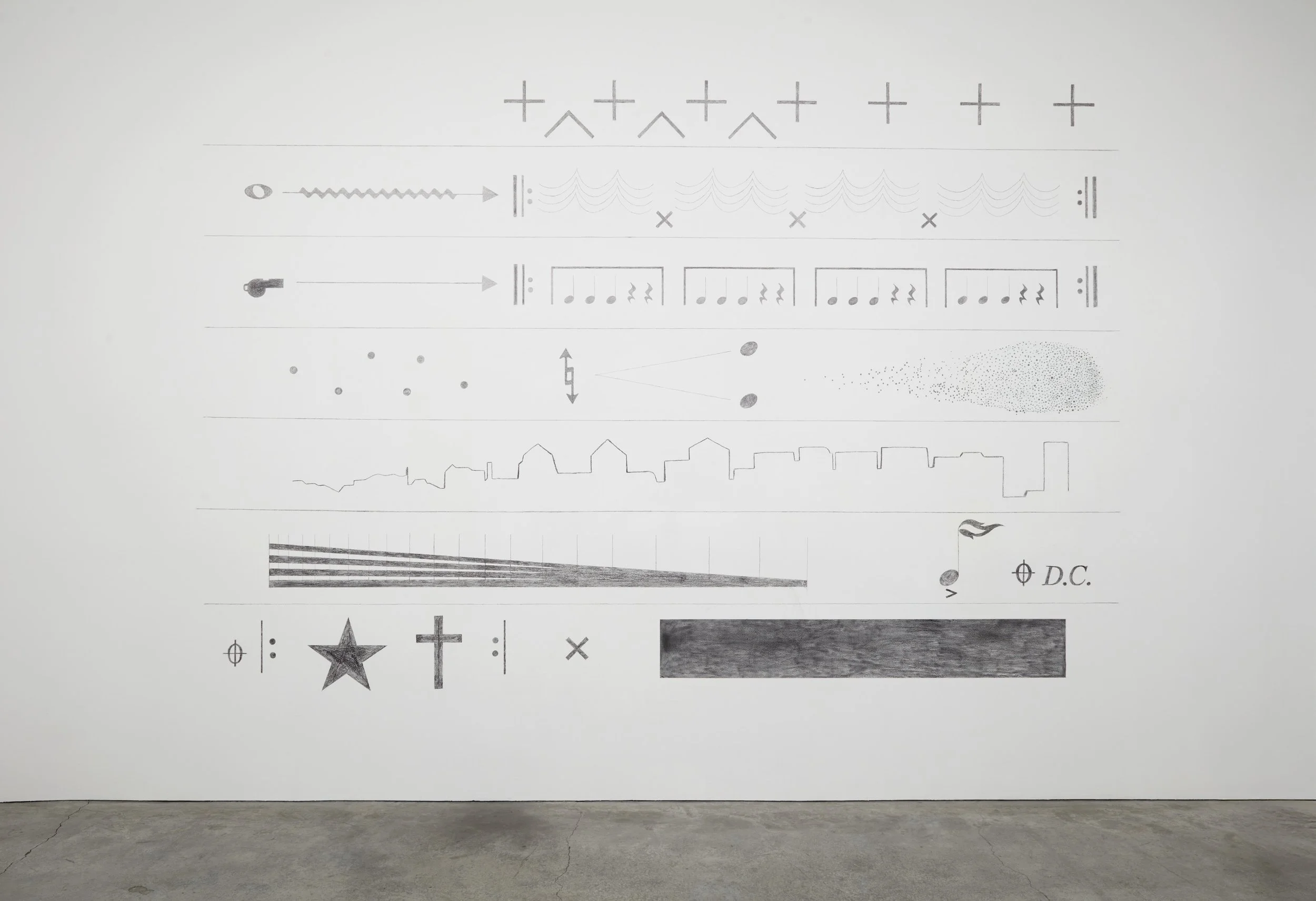
Scores for Coming Storms includes a large-scale visual score for a performance, a sound installation and accompanying textile, and ink drawings. The first work viewers encounter is American Ledger No. 1 (2018), which recounts the creation story of the United States through graphic notation and accompanying musical instructions. The work takes form as a flag, a wall, a blanket, billboard, or door; here, it is drawn in graphite directly onto the wall by Chacon, existing in this iteration solely for the duration of the show. The score’s symbology adapts traditional Western musical notation—repeat signs, whole notes, quarter rests—into a pictographic record of the land now known as the United States of America. In descending chronological order, American Ledger No. 1 moves from the blank vastness of pre-history and the subsequent evolution of Indigenous thought, through the arrival of European ships, the violence of colonial encounters, and the enactment of Western laws, religion, and industries. The final “note” of the score is an extended black band, signaling the erasure of land and Indigenous worldviews.
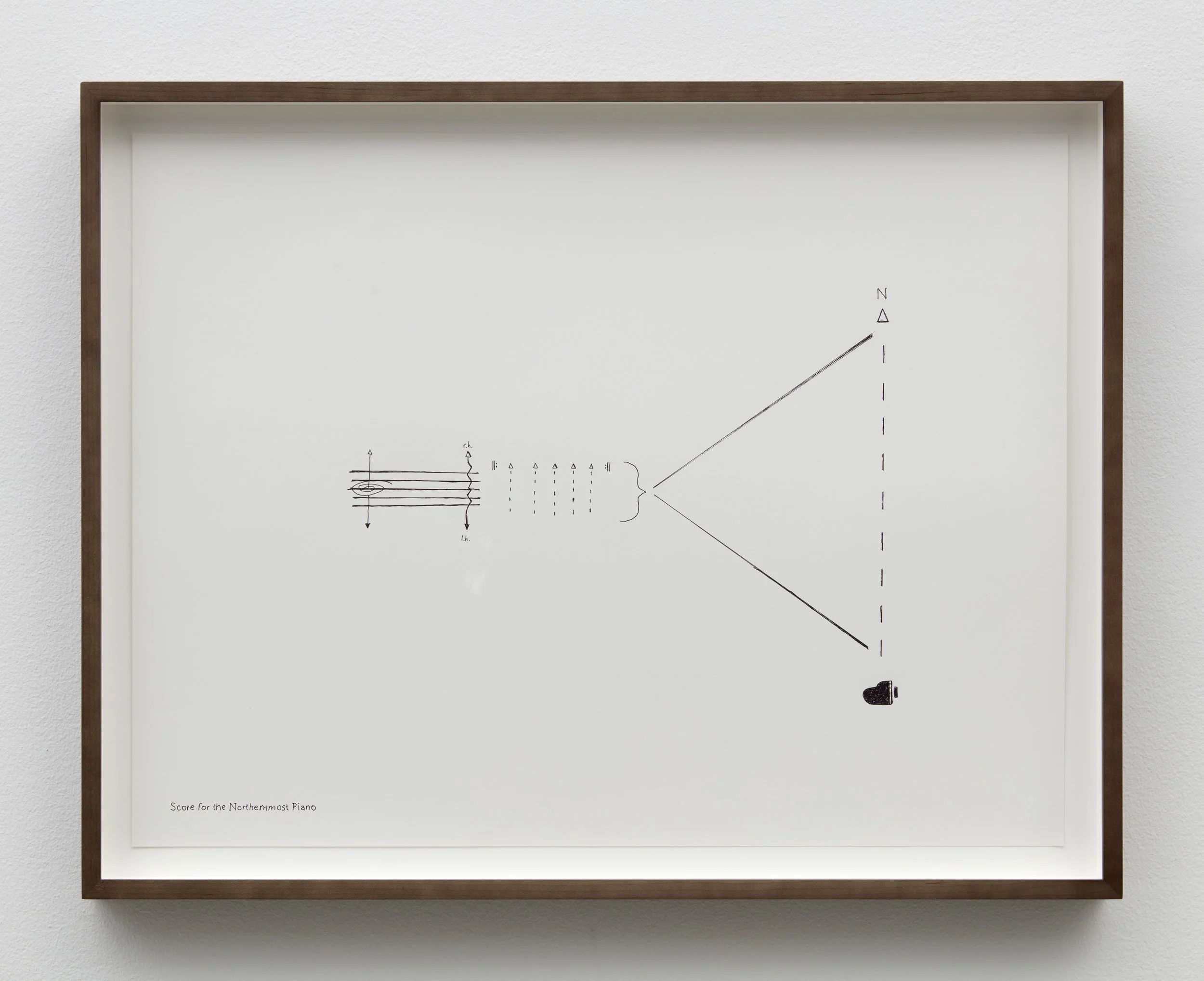
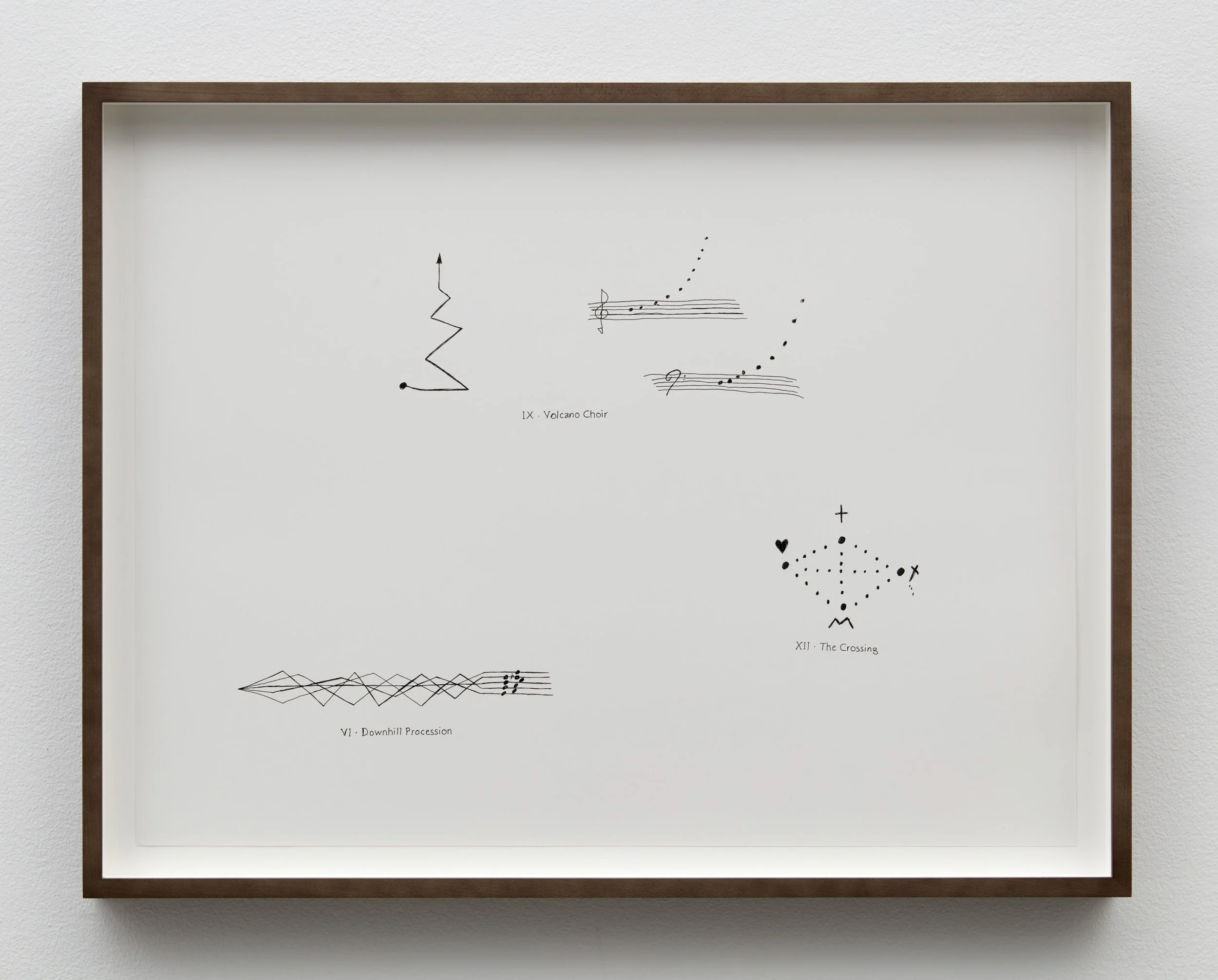
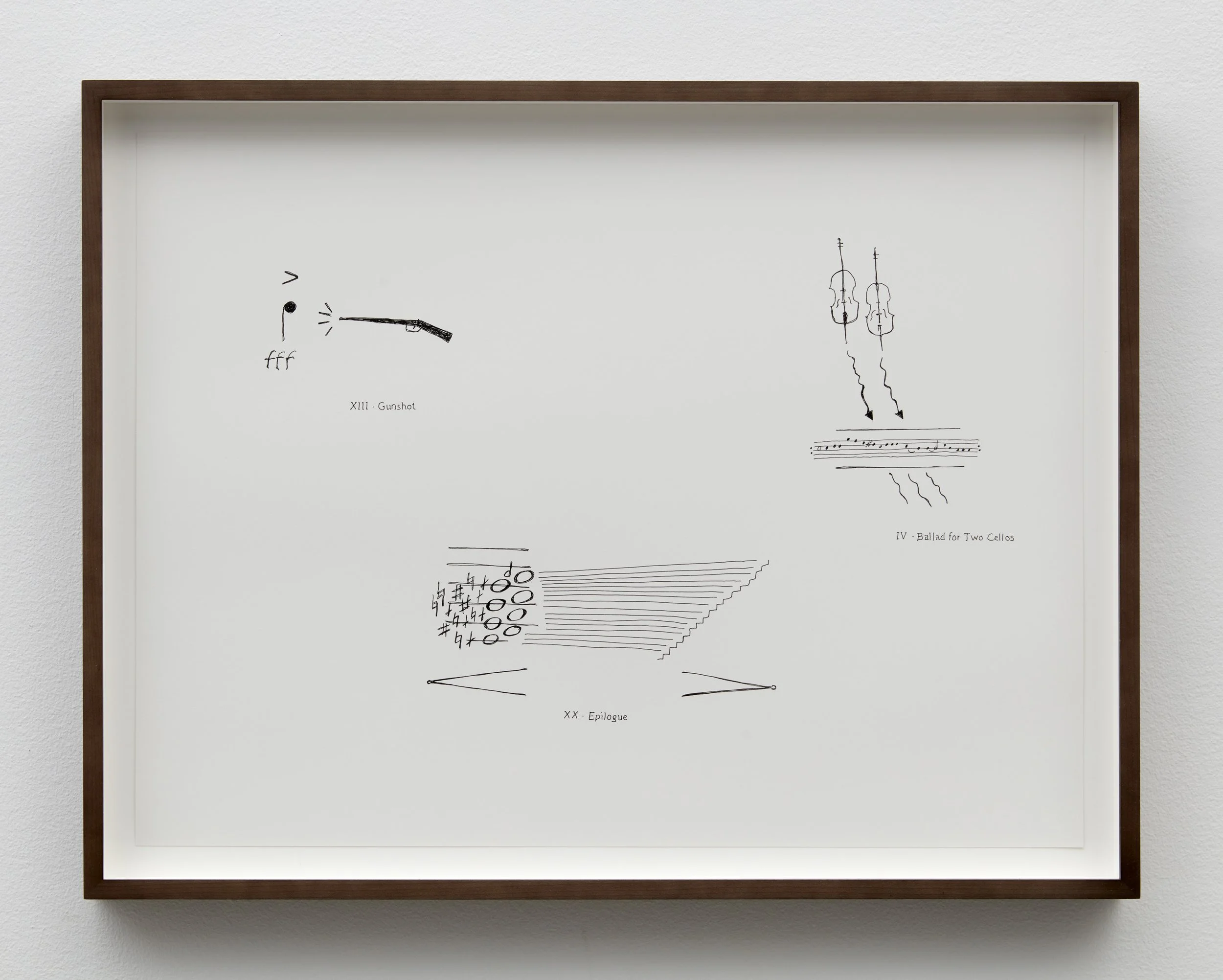
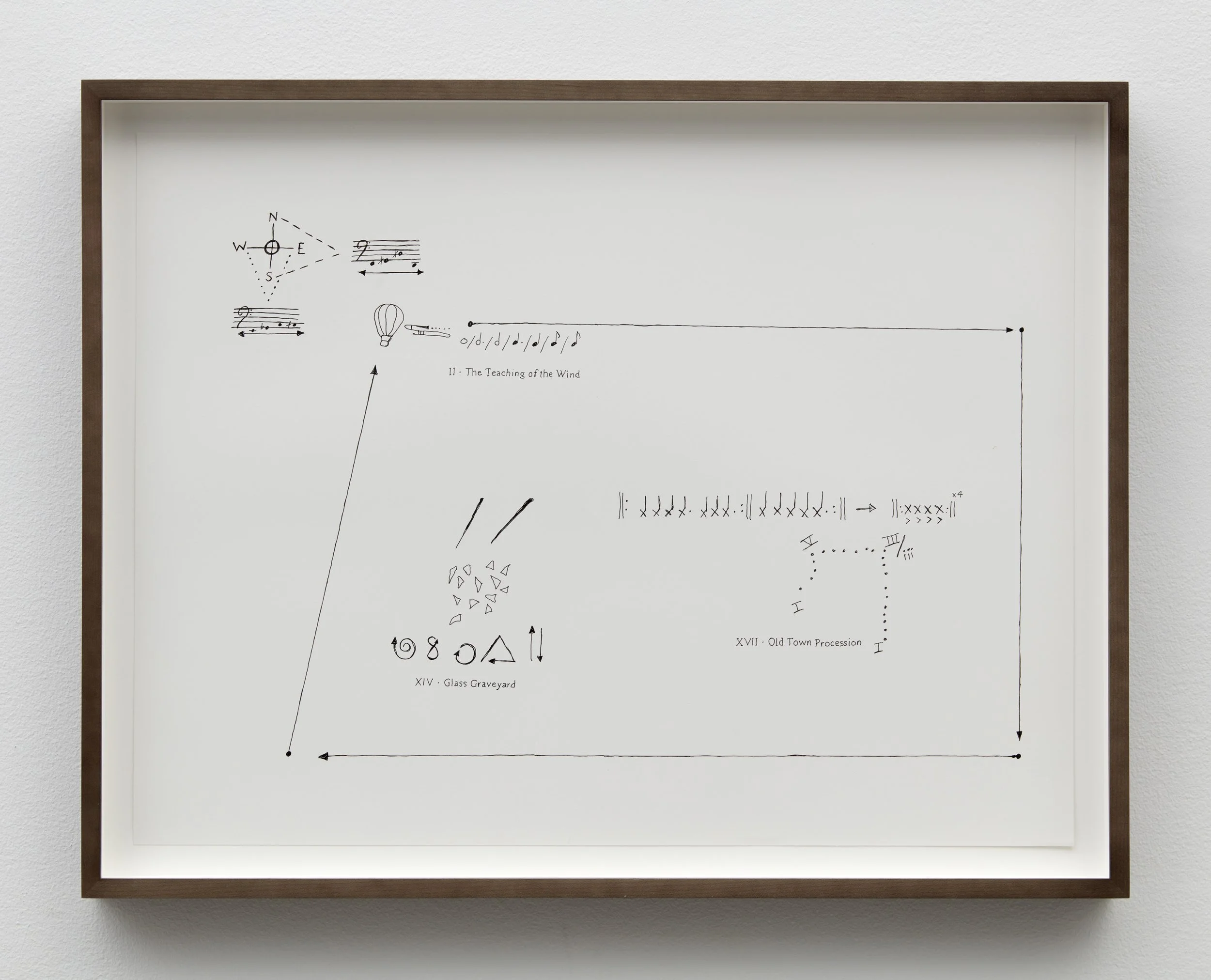
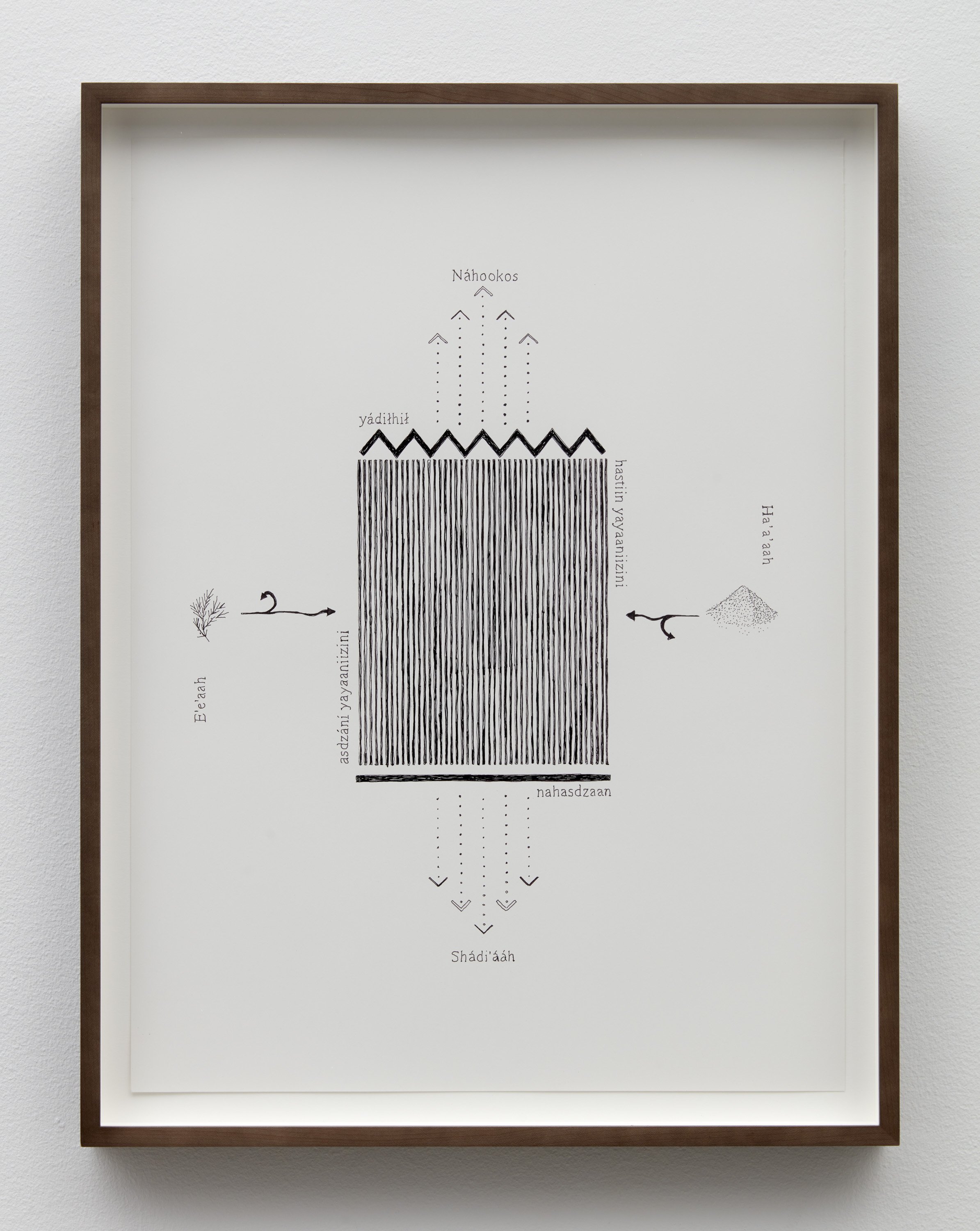
The score of American Ledger No. 1 is typically realized through a performance with sustained and percussive instruments, coins, axe and wood, a police whistle, and a match; the performance of these acoustic objects is left largely to the individual and collective interpretation of the players and their expression of the score’s accompanying text. In this exhibition, the score is not performed but displayed alongside a selection of ink drawings on paper. Three of the drawings were created for Chacon’s large-scale musical composition Tiguex, originally performed in twenty movements across the city of Albuquerque, New Mexico, on September 27, 2025. The drawings serve as visual and temporal maps of the performances, tracing the interaction of sound and landscape around the Rio Grande Valley.
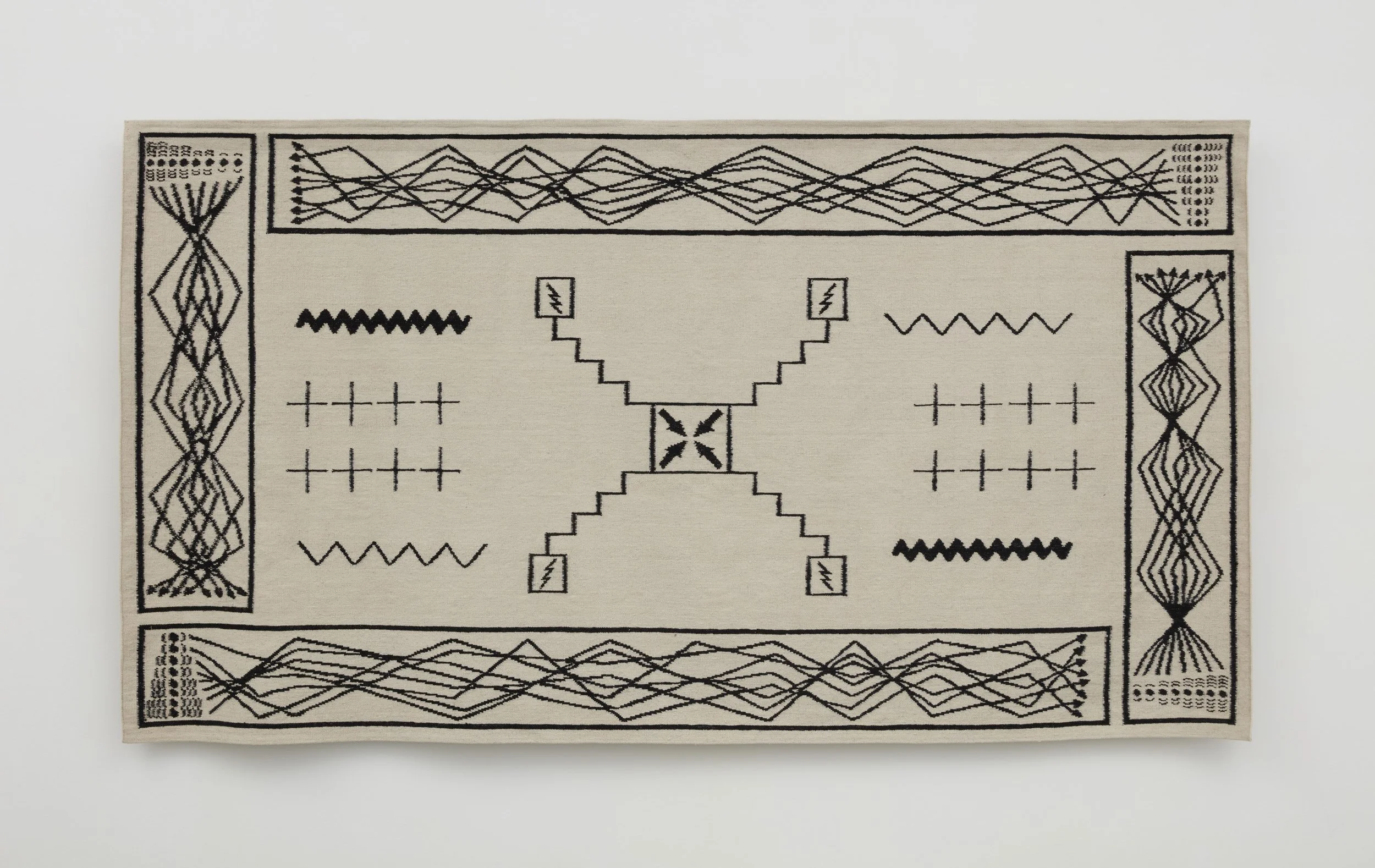
The second exhibition room is centered around Storm Pattern (2021/2024), a textile score and multi-channel sound installation composed of field recordings of flying drones at the Standing Rock Oceti Sakowin camp on Thanksgiving weekend in 2016. Capturing the flight tone of drones controlled by police, DAPL security, and the water protectors themselves, Storm Pattern relays an intertwined soundtrack of surveillance and counter-surveillance. Both the title of the installation and composition of the score reference the symbolic Navajo weaving design of the same name. Like the traditional Storm Pattern rugs, Chacon’s textile features stepped, diagonal lines radiating outward from a central rectangular element. Along the score’s perimeter are bounded channels of overlapping zigzags, transmitting iterations of sound from one corner to the next. Presented together, the soundscape and visual score of Storm Pattern respond to encroachments upon Indigenous life with a sonic vision of collective resistance and solidarity.
Raven Chacon was born in 1977 in Fort Defiance, Navajo Nation. As a solo artist, Chacon has exhibited, performed, or had works presented at The American Academy of Arts and Letters, New York; Borealis Festival, Bergen, Norway; Chaco Canyon, New Mexico; Ende Tymes Festival of Noise and Sonic Liberation, Brooklyn, New York; Haus der Kulturen der Welt, Berlin, Germany; The Los Angeles County Museum of Art, California; The Renaissance Society, Chicago, Illinois; SITE SANTA FE, New Mexico; and The Swiss Institute, New York. As a member of Postcommodity from 2009-2018, he co-created artworks presented at the Carnegie International 57, documenta 14, and The Whitney Biennial, as well as the 2-mile-long land art installation Repellent Fence. A recording artist over the span of 24 years, Chacon has appeared on more than eighty releases on various national and international labels. In 2022, he was awarded the Pulitzer Prize in Music for his composition Voiceless Mass.
Since 2004, he has mentored over 300 high school Native composers in the writing of new string quartets for the Native American Composer Apprenticeship Project (NACAP). Chacon is the recipient of a 2023 MacArthur Fellowship; a Pew Fellow Artists Residency (2022); The Foundation for Contemporary Arts Grants to Artists Award (2022); The Bemis Center for Contemporary Arts’ Ree Kaneko Award (2021); The American Academy’s Berlin Prize for Music Composition (2018); United States Artists Fellowship in Music (2016); The Native Arts and Cultures Foundation Fellowship (2014); and The Creative Capital award in Visual Arts (2012).